



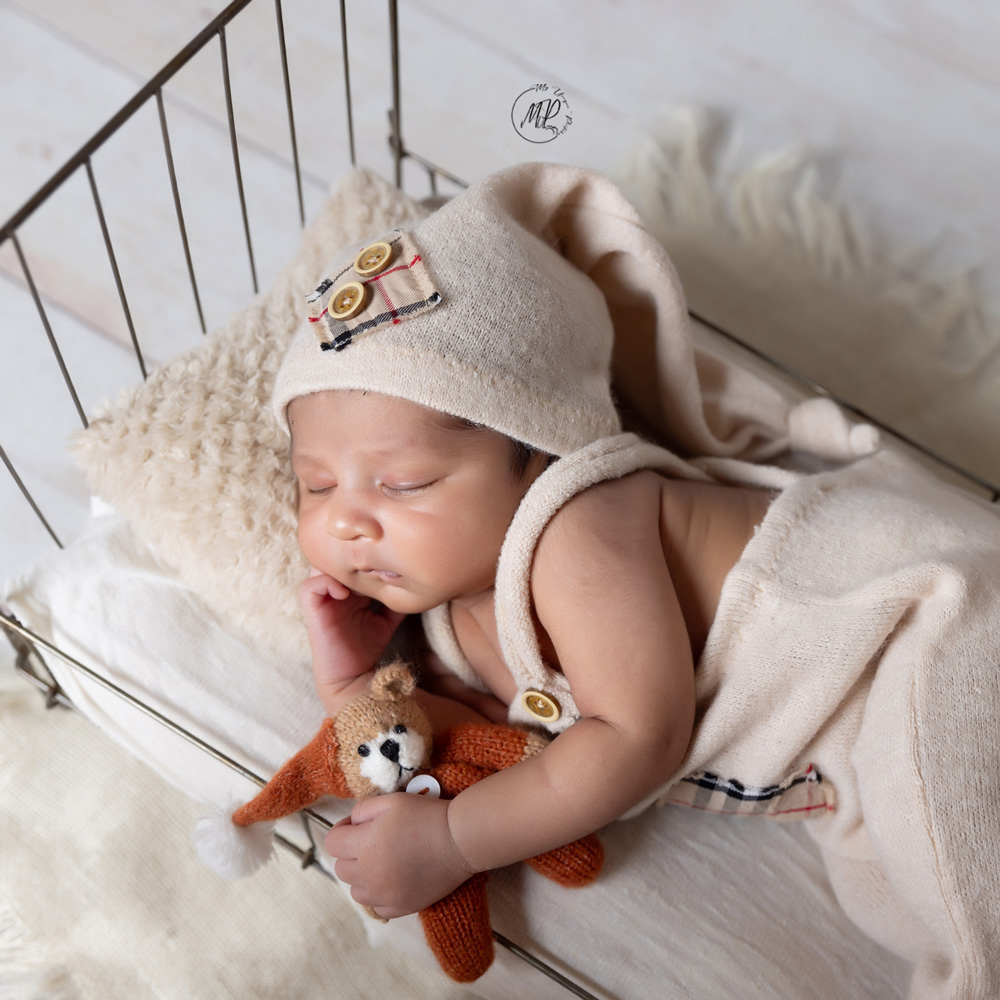
You booked your newborn session while you were still pregnant, and now you’re doing the math on a two-year-old sitting quietly in a photo studio for two hours. It doesn’t work that way, and it doesn’t have to. The order of the session is what makes the difference.
> Quick answer: For newborn photos with sibling shots, photograph the toddler in the first 15 to 20 minutes, while they’re fresh and still interested in the new room. Once the sibling images are done, one adult moves the toddler to a play spot or takes them home, and the remaining two hours belong to the baby. Plan on two or three keeper sibling photos, not twenty.
Photograph the toddler in the first 20 minutes
The sibling shots happen at the very start of the session, before anything else. A toddler walks into my Cedar Park studio curious: new lights, new blankets, a big soft beanbag. That curiosity has a shelf life of about twenty minutes, and every minute you spend on wrapped baby poses first is a minute of that goodwill you’ve spent.
Newborns cooperate with waiting. They’re 5 to 14 days old, mostly asleep, and they’ll still be sleepy in an hour. A toddler will not still be agreeable in an hour. So the baby waits and the toddler goes first, every time.
Practically, that means you arrive, I get the baby fed and warm while your toddler explores, and then we do the sibling setups back to back with no resets in between. Simple backdrop, one or two poses, done.
What a safe sibling pose actually looks like
A sibling pose puts the toddler on a stable surface first and then brings the baby to them, never the other way around. Your toddler sits cross-legged on the beanbag or in a chair with arms, we settle them, and only then do I place the baby into the space their arms are already making.
There’s always an adult within arm’s reach of the baby, usually just outside the frame with a hand on the baby, and that hand gets edited out. Your toddler is never holding the weight of a newborn on their own, and I never ask a small child to stand while holding the baby. I’m trained in newborn safety and I only do poses I’m confident doing, which is the same reason I won’t try a composite pose your toddler clearly isn’t in the mood for. If you want the longer version of how safety works in a session, I wrote about it in Is Newborn Photography Safe?.
The setups that work most reliably with a toddler under three:
- Toddler lying on their tummy next to the baby, both faces at the same level
- Toddler seated with the baby placed in their lap, adult hands supporting from behind
- Toddler kissing or touching the baby’s head while a parent holds the baby
- A detail shot of the toddler’s hand on the baby’s hand or foot, no faces needed
That last one saves a lot of sessions. If your toddler will not look at me, will not smile, and will not sit down, hands and feet still make a beautiful photo and nobody looking at it later knows there was a meltdown thirty seconds earlier.
Where your toddler goes after their photos
Once the sibling images are captured, your toddler needs somewhere to be that isn’t the set. We set up a play corner away from the shooting area with whatever you’ve brought from home, and one adult stays with them while I keep working with the baby. A tablet with headphones is completely fine here. Nobody is judging you, and a quiet toddler is worth more than a principle.
The studio has a private room for feeding and changing, so if your toddler needs a snack, a diaper change or a reset away from the lights, there’s a door to close. The room is kept warm for the baby, which most toddlers find pleasant for about ten minutes and then hot, so bring them in layers you can peel off.
You have two real options for what happens after the sibling shots, and one is easier than the other.
| Toddler stays at the studio | Toddler leaves after their shots | |
|---|---|---|
| Who you need | A second adult whose only job is the toddler | A second adult with a car seat, or a grandparent meeting you there |
| Time on site | Full 2 to 2.5 hours | About 30 to 40 minutes |
| Risk | Toddler wakes the baby, wants back on the set | Almost none |
| Bonus | Toddler can jump back in if the mood turns | You lose the chance at a second try |
Most families with a child under three do better with the second option. If grandparents are in town for the birth, this is the single best use of them.
Bring less than you think, but bring these
Pack for the toddler, not for the shoot, because I supply the newborn side already. My studio includes the props, wraps, bonnets, headbands and outfits, and on the Unique Newborn Session those are unlimited, so there’s no list of baby things for you to hunt down at 11pm.
What actually helps on the day:
- A snack your toddler loves and does not usually get, saved until after their photos
- One quiet toy or a tablet with headphones for the play corner
- A full change of clothes for the toddler, plus one for the outfit they’re photographed in
- Their comfort item, even if it’s ugly, because a ratty blanket in a photo beats no photo
- A second adult, ideally one who can leave with the toddler
Skip the bribery you announce in advance. “If you’re good you get a cookie” turns into a negotiation with a two-year-old in front of a stranger, and you will lose that negotiation. Hand over the snack after, with no conditions attached.
Common pitfalls with a toddler in the room
Most sibling sessions that go sideways go sideways for the same handful of reasons, and nearly all of them are scheduling problems rather than toddler problems.
Booking over nap. A 1pm session with a toddler who naps at 12:30 is a session you have already lost. Tell me your toddler’s nap window when you book and I’ll work around it. Morning slots are usually the safest with a child under three.
Dressing the toddler in something new. A stiff collar or shoes they’ve never worn becomes the whole story of the session. Put them in soft clothes they already like, in a color that sits near what the baby is wrapped in. If you want help with coordinating everyone, family photo outfit ideas and color schemes covers how to pick a palette without matching.
Asking for a smile. Telling a toddler to smile produces the clenched fake grin every parent recognizes. I’d rather get them laughing at something silly, or catch them looking down at the baby, which is the photo you’ll actually want on the wall anyway.
Expecting the toddler to be delighted. Some two-year-olds adore the new baby by day ten. Some are still deciding. A photo of your toddler sitting near the baby with a serious face is an honest picture of that week, and in five years it will be the one that makes you laugh.
Waiting until after the birth to sort out the sibling plan. Newborn timing is tight, ideally 5 to 10 days old, so there isn’t much room to rearrange childcare once the baby is here. I hold your date by due date rather than a fixed day, and there’s more on how that works in the real timeline for booking newborn photography in Austin.
What a sibling costs to include
A sibling is included in the newborn collections, not an upsell tacked on at checkout. The Unique Newborn Session is $550 for up to 2.5 hours in studio with parents plus one sibling, and you get 15 hand-edited images in both color and black and white. The Sweet Newborn Session is $490 for up to 2 hours with parents or one sibling, and 13 images. Extra family members can be added for a fee, so if you have two older children or grandparents coming, tell me when you book and I’ll quote it and build the extra time in. All of the newborn and maternity pricing is on the collections page.
The other thing that buys you room is time. A 2.5-hour session sounds long until you’re twenty minutes in with a toddler who needs a snack and a baby who needs a feed. I don’t like to be rushed, and that unhurried pace is exactly what makes a session with two kids survivable.
FAQ
How old should my toddler be for newborn photos with sibling shots?
Any age works, but the approach changes. Under 18 months, your toddler will mostly be placed rather than posed, and the best images are lying-down shots and hand details. Between two and four, your toddler can follow simple directions for short stretches, which is when the classic “big sibling holding the baby” photo gets easiest. Over five, kids usually enjoy the whole thing and can stay for more of the session.
Can my toddler hold the baby in the photos?
Your toddler can hold the baby in a seated, fully supported pose with an adult’s hands on the baby the entire time. I never ask a young child to hold a newborn standing up or without support, and I’ll place the baby myself rather than handing the baby over. If your toddler is squirmy that day, we switch to poses where a parent holds the baby and the toddler leans in.
What if my toddler melts down and refuses to cooperate?
A meltdown is normal and it isn’t the end of the session. We stop, your toddler goes to the play corner with a snack, and I move on to the baby. Toward the end, if your toddler has recovered, we try the sibling shots one more time for five minutes. Roughly half the time the second attempt is the one that works.
How long does my toddler have to stay at the studio?
Your toddler needs to be there about 30 to 40 minutes for a newborn session with sibling photos. That covers arriving, settling, and the sibling setups. After that, most families have the second adult take the toddler home while mom stays with the baby for the rest of the session.
Should I book newborn photos with sibling shots, or a separate family session later?
Book the sibling shots into the newborn session, because the curled-up newborn look only lasts about two weeks and your toddler will never again be that size next to that baby. A separate family session a few months later is a different photo entirely, and plenty of families do both. You can see examples of each in the newborn and family galleries.
If you’re expecting and already wondering how your older one will handle the day, tell me their age and nap schedule when you say hello and I’ll plan the running order around them before your baby even arrives. I reply within 24 hours.